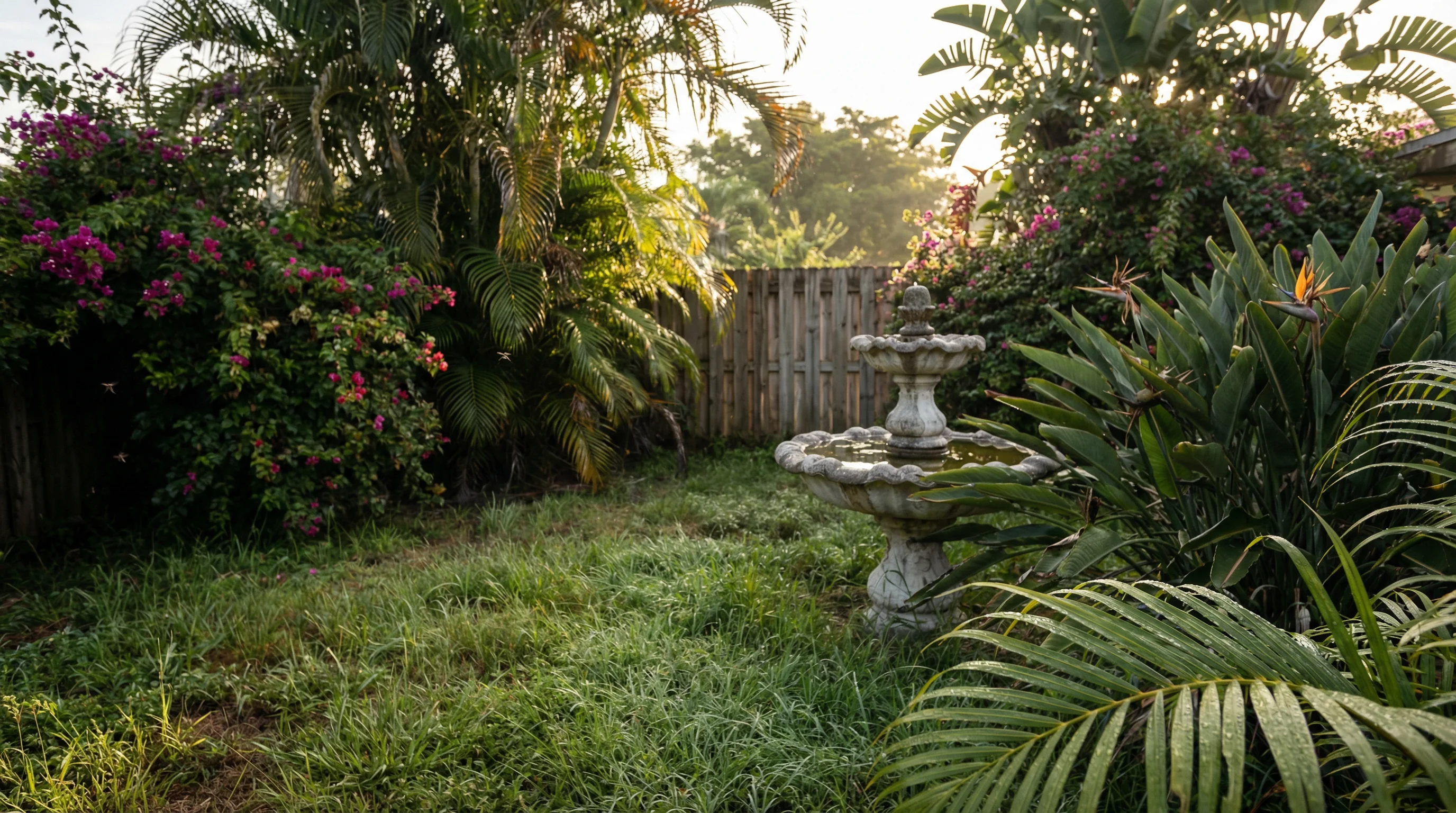

I have been doing pest control in Miami-Dade for over 17 years. Every spring, I watch the same thing happen: the temperature climbs, the humidity rolls in off the bay, and my phone starts ringing. Homeowners who had no pest problems all winter are suddenly dealing with ghost ants in the kitchen, termite swarmers coming out of the walls, and mosquitoes that make the backyard unusable.
This is not bad luck. It is biology. South Florida's climate is essentially a year-round incubator for pests, and spring is when that incubator kicks into high gear. The good news is that if you know what to look for and act early, you can stay ahead of it. This guide covers the five pests I am seeing the most of right now in Miami-Dade, what makes each one dangerous, and what actually works to control them.
I am writing this as a licensed pest control operator, not as a marketing exercise. I am going to tell you what I tell my own customers: the honest truth about what you are dealing with and what it takes to fix it.
2026 Miami-Dade Pest Season at a Glance
| Pest | Peak Season | Threat Level | Primary Concern |
|---|---|---|---|
| Ghost Ants | June to October | Moderate | Food contamination, colony budding |
| Subterranean Termites | March to June (swarm) | High | Structural damage, silent destruction |
| Mosquitoes | May to October | High | Dengue, Zika, West Nile transmission |
| Roof Rats | Year-round | High | Electrical fires, disease, structural damage |
| German Roaches | Year-round, peaks summer | High | Rapid reproduction, pesticide resistance |
Ghost Ants
Tapinoma melanocephalum
If you have ever watched a trail of nearly invisible ants disappear into your kitchen counter and wondered whether you were imagining things, you were not. Ghost ants are one of the most frustrating pests in South Florida, and they are everywhere right now.
Ghost ants get their name from their pale, almost translucent legs and abdomen. The only part you can really see is the dark head and thorax, which makes them look like tiny floating specks. They are about 1.3 to 1.5 millimeters long, which means a trail of them can be almost impossible to spot until the infestation is well established.
What makes ghost ants particularly difficult is their colony structure. Unlike fire ants or carpenter ants, which have a single queen, ghost ant colonies are polygyne, meaning they can have dozens of queens spread across multiple satellite nests. When homeowners spray them with a store-bought product, the colony does not die. It fractures. You end up with more nests in more places, and the problem gets worse.
Ghost ants are moisture-dependent. They love kitchens and bathrooms, and they are particularly attracted to sweet foods and honeydew produced by aphids on outdoor plants. In spring and summer, as humidity climbs and the rainy season approaches, their populations explode.
The right approach is slow-acting gel bait placed along their trails, combined with a perimeter treatment to reduce outdoor populations. Worker ants carry the bait back to the queens, and the whole colony collapses over one to two weeks. It is not instant, but it works.
Warning
Do not spray ghost ants with aerosol products. It causes colony budding, which multiplies the problem.
Recommended Treatment
Perimeter baiting + interior gel bait placements
Subterranean Termites
Reticulitermes flavipes / Coptotermes formosanus
Every spring, I get a wave of calls from homeowners who woke up to find hundreds of winged insects crawling out of their walls or swarming around their windows. That is a termite swarm, and it is one of the most alarming things a homeowner can witness.
Subterranean termites are the most destructive pest in the United States, causing an estimated five billion dollars in structural damage annually, according to the National Pest Management Association (NPMA). In South Florida, we deal primarily with two species: the Eastern subterranean termite (Reticulitermes flavipes) and the Formosan subterranean termite (Coptotermes formosanus). The Formosan is the more aggressive of the two and is well established throughout Miami-Dade County.
Subterranean termites live in the soil and build mud tubes to travel from the ground into the wood of your home. They work silently and continuously, 24 hours a day. A mature Formosan colony can contain millions of workers and consume a pound of wood per day. By the time most homeowners notice damage, the colony has been active for years.
The swarm is actually a sign of a mature, healthy colony. Reproductive alates (the winged termites) leave the nest to start new colonies. If you see a swarm inside your home, it almost certainly means the colony is already established in your structure, not just nearby. For a full breakdown of swarm timing, species identification, and what to do the moment you see them, read our dedicated guide: Termite Swarm Season in South Florida.
Treatment for subterranean termites typically involves a liquid termiticide barrier applied to the soil around the foundation, bait stations, or a combination of both. The Sentricon system, which uses bait that workers carry back to the queen, is highly effective for Formosan termites. A WDO (Wood-Destroying Organism) inspection is the right starting point if you have any suspicion of activity.
Warning
Swarmers inside your home mean the colony is already in your structure. Call immediately.
Recommended Treatment
Liquid termiticide barrier or bait system + WDO inspection
Mosquitoes
Aedes aegypti / Culex quinquefasciatus
I got a call last spring from a customer in Pinecrest. She told me the mosquitoes were so bad they were trying to fly away with her Yorkie. I laughed, but honestly, she was not exaggerating by much. We set her up on the Perimeter Defense System, and she has not had a problem since.
South Florida has some of the most intense mosquito pressure in the country. We have year-round warmth, a rainy season that dumps sixty inches of water on Miami-Dade between June and September, and dense tropical landscaping that creates ideal harborage. The result is a mosquito population that is active ten to eleven months out of the year.
The two species that matter most from a public health standpoint are Aedes aegypti, the primary vector for dengue fever and Zika virus, and Culex quinquefasciatus, the primary vector for West Nile virus. Aedes aegypti is a container breeder, which means it lays eggs in any standing water it can find: a bottle cap, a clogged gutter, a decorative fountain, a plant saucer. It does not need a pond. It needs a teaspoon.
Source reduction is the foundation of any effective mosquito program. That means eliminating every source of standing water on the property: emptying plant saucers weekly, cleaning gutters, turning over buckets, and treating ornamental water features with Bacillus thuringiensis israelensis (Bti), a biological larvicide that is safe for pets and wildlife.
For properties with significant pressure, a professional perimeter misting program treats the foliage, harborage areas, and property edges where mosquitoes rest during the day. Our Perimeter Defense System provides scheduled, season-long suppression. The customer in Pinecrest with the Yorkie? She went from calling us in a panic to sending us referrals.
Warning
Aedes aegypti breeds in as little as a teaspoon of standing water. Check plant saucers, gutters, and decorative containers weekly.
Recommended Treatment
Source reduction + Perimeter Defense System (PDS) misting program
Roof Rats
Rattus rattus
Roof rats are the pest that surprises homeowners the most. People expect rats to come in through the garage or the back door. What they do not expect is to hear scratching in the ceiling at 2 AM and realize something is living in their attic.
Roof rats, also called black rats or ship rats, are exceptional climbers. They can run along power lines, scale stucco walls, and squeeze through a gap the size of a quarter. In Miami-Dade, the combination of mature tree canopies, fruit trees, and older housing stock with gaps in the roofline creates ideal conditions for roof rat populations.
They are primarily nocturnal, which is why the scratching in the attic is usually the first sign. Other indicators include gnaw marks on fascia boards, roof vents, or soffit material; grease marks along rafters or joists; and droppings about half an inch long with pointed ends. If you have fruit trees and you are finding half-eaten fruit on the ground, roof rats are a likely culprit.
Roof rats are not just a nuisance. They gnaw on electrical wiring, which creates a fire hazard. They contaminate insulation with urine and droppings. They carry leptospirosis, rat bite fever, and other pathogens. A single female can produce four to six litters per year, with six to eight pups per litter, so a small problem becomes a large one quickly.
Effective control requires a Rodent Defense Audit: a thorough inspection of the property to identify all entry points, followed by mechanical exclusion (sealing gaps with hardware cloth, copper mesh, and appropriate sealants) and population reduction using tamper-resistant bait stations. Trapping alone without exclusion is a losing battle. The rats will keep coming back until you seal the building.
Warning
Roof rats gnaw electrical wiring. An active infestation is a fire hazard, not just a nuisance.
Recommended Treatment
Rodent Defense Audit + mechanical exclusion + bait stations
German Cockroaches
Blattella germanica
German roaches are the pest I take most seriously. Not because they are the biggest or the most dangerous, but because they are the hardest to eliminate once they are established, and they reproduce faster than almost any other pest we deal with.
A single female German cockroach can produce an egg capsule containing 30 to 40 eggs every three to four weeks. Under ideal conditions, a pair of German roaches can produce tens of thousands of descendants in a single year. They develop resistance to pesticides faster than almost any other insect, which is why the spray-and-pray approach that worked twenty years ago often fails today.
German roaches are not the large outdoor roaches (Periplaneta americana, the palmetto bug) that fly in through open doors. They are small, about half an inch to five-eighths of an inch, and they live almost exclusively indoors. They prefer warm, humid environments close to food and water: the motor compartment of a refrigerator, the inside of a dishwasher, under a kitchen sink, behind a stove.
They are also hitchhikers. The most common way German roaches enter a home is inside a grocery bag, a cardboard box, a secondhand appliance, or furniture. In multi-family buildings, they travel through shared plumbing chases and electrical conduits. A neighbor's infestation can become your infestation overnight.
Our German Roach Elimination Program uses a structured three-visit protocol: an initial treatment with gel bait, insect growth regulators (IGRs), and HEPA vacuuming to remove egg capsules, followed by two follow-up visits to address any surviving populations and confirm the colony has been eliminated. The program is backed by a 90-day guarantee. We do not consider the job done until the roaches are gone.
Warning
German roaches develop pesticide resistance rapidly. Over-the-counter sprays often make infestations worse by scattering the population.
Recommended Treatment
3-visit German Roach Elimination Program with gel bait, IGRs, and HEPA vacuuming
The Bottom Line: Do Not Wait Until It Is Obvious
The single most common thing I hear from new customers is some version of "I thought it would go away on its own." It almost never does. Pest populations do not self-correct in South Florida's climate. They grow. A ghost ant trail in April becomes a full kitchen infestation by July. A termite swarm in March means a colony that has been eating your home for years. A handful of mosquitoes in May means thousands by August.
The most cost-effective pest control is preventive pest control. A Residential Protection Program (RPP) that treats the perimeter of your home on a regular schedule costs a fraction of what it costs to remediate a termite infestation or a rodent exclusion job after the fact. I have seen homeowners spend fifteen thousand dollars on structural repairs that a few hundred dollars a year in preventive service would have avoided.
If you are seeing any of the pests described in this guide, or if you just want to make sure your home is protected before the summer season hits, give us a call. We serve all of Miami-Dade County, from Homestead and Florida City up through Pinecrest, Coral Gables, Kendall, Cutler Bay, and Palmetto Bay. We will come out, do a thorough inspection, and give you an honest assessment of what you are dealing with and what it will take to fix it.
No pressure. No upselling. Just straight answers from someone who has been doing this in this county for a long time.
Shaun Judy
Founder & CEO, Dade Pest Solutions
FDACS Certified Operator License JF293201