Key Takeaways
- Vikane is the most reliable way to eliminate 100% of an active drywood termite colony inside the wood of a South Florida home.
- Vikane is a gas, not a spray. It leaves no surface residues on dishes, clothes, furniture, electronics, or art.
- Federal law requires the home to be aerated to 1 ppm or less before re-entry, verified with calibrated clearance equipment.
- A typical residential fumigation in Homestead involves 16 to 30 hours of exposure, plus aeration and clearance testing.
- Vikane has no residual effect; it kills only the pests present at the time of treatment, which is why prevention afterward matters.
| Fast Facts | |
|---|---|
| Active ingredient | Sulfuryl fluoride (99.8%) |
| Year first marketed | 1961 |
| Buildings fumigated | 3+ million |
| EPA re-entry limit | ≤ 1 ppm TWA |
| Typical exposure time | 16–30 hours |
| Homeowner displacement | 2 nights / 3 days |
| Surface residue | None |
| Residual pest barrier | None |
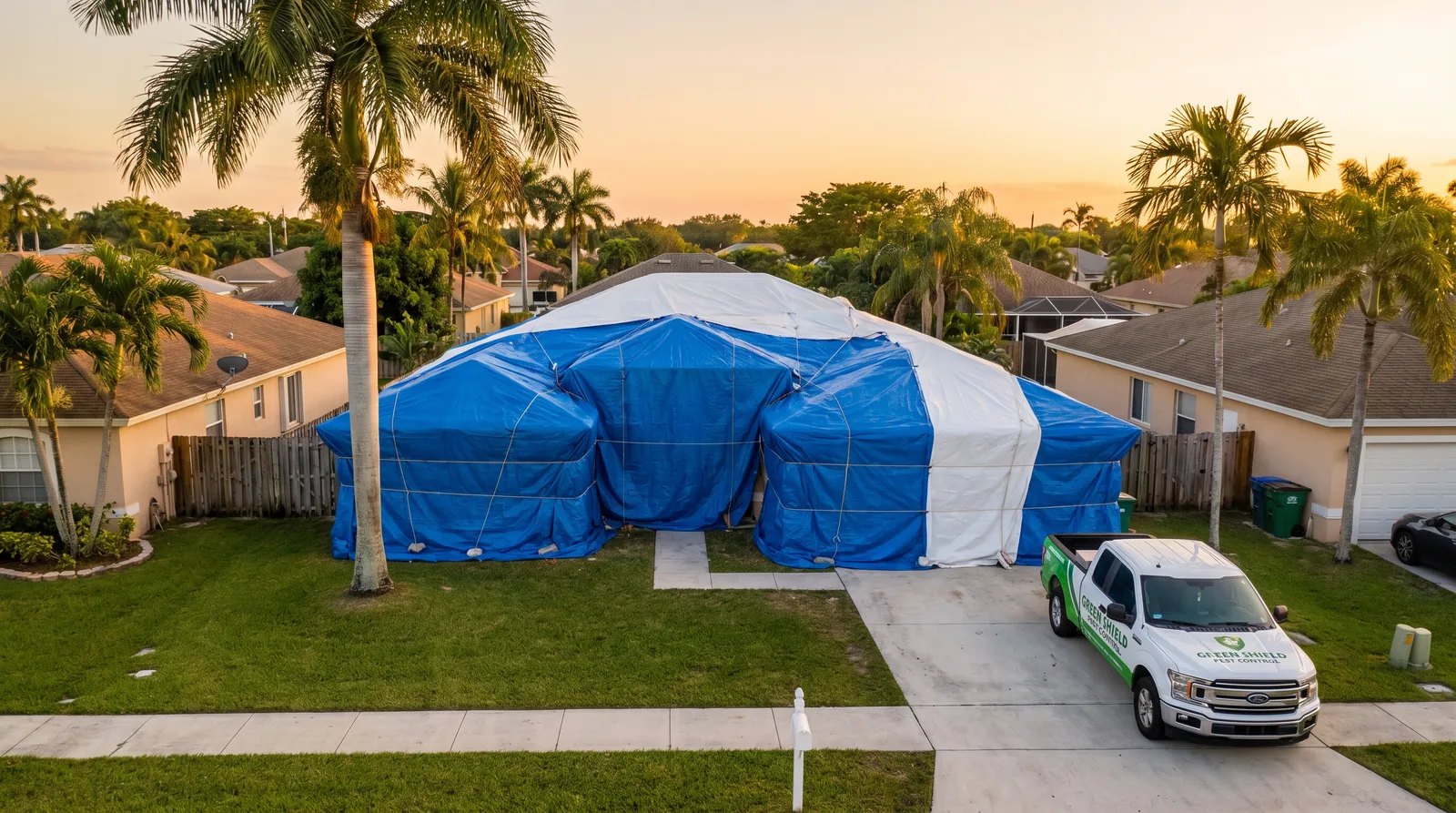
If you live in Homestead, Cutler Bay, Princeton, Pinecrest, Palmetto Bay, or anywhere across South Miami-Dade, you have probably seen a neighbor's house wrapped in a colorful tarp at some point. That is tent fumigation, and in our part of Florida it is most often done to eliminate drywood termites.
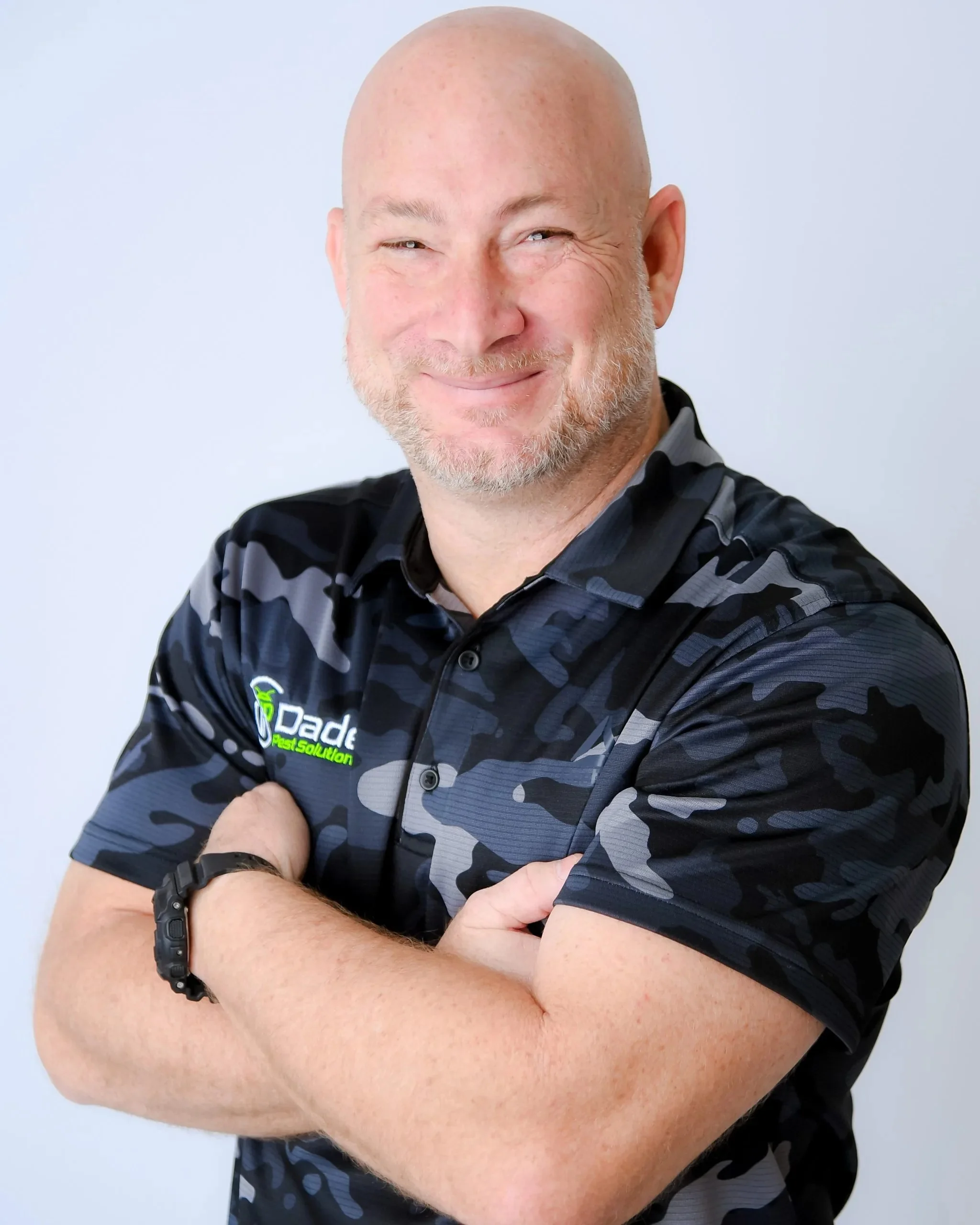
South Florida's warm, humid, coastal climate is exactly what the West Indian drywood termite (Cryptotermes brevis) and other drywood species love, and Miami-Dade is one of the heaviest infestation zones in the country. I am Shaun Judy, founder and CEO of Dade Pest Solutions, a family-owned company right here in Homestead. We hold Florida Department of Agriculture and Consumer Services license JB337153, and we have spent years walking homeowners through the fumigation process. The questions below are the ones I hear most often, and I want to answer them the way I would explain them to a neighbor at the kitchen table.
1. What Is Vikane, and What Is Tent Fumigation?
Vikane is the brand name of a structural fumigant manufactured by Douglas Products. Its active ingredient is sulfuryl fluoride, a colorless, odorless gas that fills every air space inside a sealed structure to kill wood-destroying and structure-infesting pests. Vikane was first marketed in 1961 and has since been used to fumigate more than 3 million buildings.
"Tent fumigation" simply describes the method. We cover the entire home with heavy tarps, seal the seams to the ground, then introduce Vikane through tubing into the airstream of fans inside. The gas penetrates wood, drywall, furniture, and even the tiny galleries inside an infested beam where termites are hiding. It is the only treatment method proven to achieve 100% elimination of drywood termite colonies, including colonies hidden in roof rafters, attic framing, and wall studs where no inspector can physically reach.
2. Why Is Fumigation Necessary for Drywood Termites in South Florida?
Drywood termites live their entire lives inside the wood they eat. They do not need contact with soil or moisture from the ground, which is why traditional soil treatments do not work on them. In Homestead, Cutler Bay, Palmetto Bay, Pinecrest, South Miami, Coral Gables, and Kendall, drywood termites swarm in the warm months and can establish colonies inside any wooden structure.
Spot treatments may help with a single accessible piece of wood, but once an infestation has spread through roof trusses and wall cavities, whole-structure fumigation is the dependable answer. Our Termite Risk Mitigation Plan includes a thorough inspection to determine whether localized treatment or full fumigation is the right call for your home.
Why This Matters
Miami-Dade is one of the highest drywood termite pressure zones in the United States. The University of Florida IFAS Extension confirms that Florida has more termite species than any other state in the continental U.S. Once a drywood colony spreads into roof framing, fumigation is the only treatment with a proven 100% elimination rate.
3. Is Vikane Safe for My Family and Pets When We Return Home?
Yes, when the fumigation is performed by a properly licensed and trained fumigator and the home is cleared for re-entry. Inhalation is the only meaningful route of exposure, since Vikane is a gas and is not absorbed through skin in toxic amounts.
The U.S. Environmental Protection Agency has set a Permissible Exposure Limit of 1 part per million as a Time Weighted Average. That level is considered safe for everyone, including infants, children, the elderly, and pregnant women. Federal law requires the fumigator to verify that concentrations are 1 ppm or less in every breathing zone before posting the home as safe to re-enter. For perspective, modeling shows that the peak plasma fluoride from Vikane at the 1 ppm re-entry level is actually lower than the peak plasma fluoride from drinking fluoridated tap water.
Toxicology studies in lab animals over periods ranging from 2 weeks to 2 years have shown Vikane is not teratogenic, not carcinogenic, and produces no developmental or reproductive effects. This is exactly why the EPA classifies Vikane as a Restricted Use Pesticide and limits its application to certified, trained professionals.
Vikane also uses a required warning agent called chloropicrin, released 5 to 10 minutes before Vikane goes in. Chloropicrin causes eye tearing and irritation at very low concentrations, so anyone who somehow remained in the building would be driven out immediately. It is a built-in safety mechanism, not a health risk.
4. Will Vikane Leave Residue on My Dishes, Furniture, or Clothes?
No. This is one of the most common worries I hear, and the answer is simple: Vikane is a gas, not a spray or fog. It does not form toxic surface residues. Dishes, clothes, cooking utensils, countertops, and bedding do not need to be washed after fumigation. The gas fully dissipates during aeration and is non-detectable in the home after clearance. This is also why museums use sulfuryl fluoride to fumigate delicate artifacts. It does not chemically react with materials.
What About Food and Medications?
Federal label requirements are very specific. Food, feed, drugs (including tobacco products), and medicinals can stay in the home if they are sealed in plastic, glass, or metal bottles, cans, or jars with the original manufacturer's airtight seal intact. Anything that has been opened, or anything in cardboard, paper, or fabric packaging, must either be removed or double-bagged in special nylon Nylofume bags that we provide.
Research has shown that food double-bagged in Nylofume and exposed to ten times the standard drywood termite dosage had no detectable sulfuryl fluoride or fluoride residues afterward. So when we tell you the bags work, that is backed by data, not marketing.
5. How Do I Prepare My Home for Fumigation?
We provide a written checklist before service so nothing is missed. Here is the short list, based directly on the Vikane label requirements:
- Remove all people, pets, and desirable indoor plants. Fish tanks require special handling we will discuss with you.
- Remove mattresses and pillows that are completely encased in waterproof covers, unless you can open or remove the covers. Waterbeds are fine and do not need to be removed.
- Turn off all open flames, pilot lights, and glowing heating elements. Coordinate with your natural gas or propane provider as needed.
- Open every interior door, attic hatch, sub-area access, storage chest, cabinet, drawer, closet, washer, dryer, and oven.
- Double-bag any food, feed, drugs, tobacco, or medicinals that are not in unopened plastic, glass, or metal containers with intact factory airtight seals. We supply Nylofume bags for this.
- Water the soil and plantings around the foundation the day before so the soil acts as a seal.
- Make sure we have keys to all locked rooms or gates, and remove any awnings, trellises, or antennas that would interfere with the tarp.
Plants and landscaping: All desirable growing plants inside the home must be moved out before fumigation. We ask you to thoroughly water the soil and shrubs around the foundation the day before. Wet soil acts as a barrier that limits gas loss into the ground and helps protect the roots of plants growing close to the house.
6. How Long Does the Fumigation Take, and What Happens During It?
A typical residential fumigation in Homestead involves 16 to 30 hours of exposure under the tent. When you add tarp setup the first day, the exposure period overnight, and aeration plus clearance testing on the final day, most homeowners are out of the house for two nights and part of three days.
Warmer weather actually shortens the dose required because insects metabolize faster, which is one of the few advantages of fumigating in the South Florida heat. The dosage is calculated as concentration multiplied by time, measured in "ounce-hours." We use the Vikane Fumiguide calculator to determine the precise dose for the target pest, life stage being controlled, and temperature.
Vikane works at the cellular level. In insect eggs it reduces oxygen uptake, and in later life stages it disrupts glycolysis, which prevents the insect from metabolizing the stored fats it needs for energy. The pest essentially runs out of fuel and dies. Insects that have received a lethal dose may still appear alive immediately after the tent comes off, but they will not survive.
7. What Happens After Fumigation, and Will Termites Come Back?
Aeration is the final and most carefully regulated step. After the exposure period, we remove or open the tarps, set fans, and open cabinets, drawers, closets, and windows so the gas can diffuse out of materials. Vikane has a very high vapor pressure and a boiling point of -67°F, so it moves out of the structure quickly into the open air, where it dissipates to non-detectable levels.
A specially trained technician then uses calibrated clearance equipment to measure the actual concentration in every breathing zone. We do not post the home as safe to re-enter until those readings are 1 ppm or less. Often, after proper aeration, Vikane is non-detectable.
This is the single most important fact for homeowners to understand: Vikane has no residual effect. It eliminates only the pests present in the structure at the time of fumigation. It does not leave a barrier behind, and it does not stop new swarmers from flying in next season and starting a new colony.
In South Florida, where drywood termite swarmers are active for much of the year, that means follow-up matters. After fumigation we typically recommend ongoing inspections, attic checks during swarming season, and sometimes a localized preventive treatment program. Our Termite Risk Mitigation Plan includes annual monitoring visits to catch new activity before it spreads. We also offer WDO Inspections for real estate transactions and annual peace-of-mind checks.
Vikane is also labeled to control bed bugs, cockroaches, clothes moths, rodents, spiders, carpet beetles, and wood-boring beetles. For most South Florida homes, drywood termites are the reason we tent. But we sometimes use the same treatment to take care of severe bed bug infestations or hard-to-reach beetle problems in the same visit.
Florida law requires every pest control company performing fumigation to hold the appropriate FDACS license, and individual fumigators must complete initial and annual stewardship training under the Vikane Stewardship Plan. You can verify any company's license through the FDACS Pest Control Operator search. Dade Pest Solutions holds Florida license JB337153, and we are happy to show our credentials before you sign anything.
A local family-owned company brings two real advantages: we live where you live, and we are accountable. South Florida construction, from older Homestead bungalows to newer Princeton and Leisure City builds, has its own quirks. Knowing how barrel-tile roofs seal, how slab-on-grade homes vent, and how to coordinate with the local gas providers makes a meaningful difference in how smoothly your fumigation goes. When you call us, you reach the people who actually do the work.
Shaun Judy
Founder and CEO, Dade Pest Solutions
FDACS Certified Operator License JF293201
Serving Homestead, Cutler Bay, Palmetto Bay, Pinecrest, South Miami, Coral Gables, Kendall, and all of Miami-Dade County
Frequently Asked Questions
Ready to Schedule Tent Fumigation?
Our FDACS-certified team serves Homestead, Cutler Bay, Palmetto Bay, Pinecrest, South Miami, Coral Gables, Kendall, and all of Miami-Dade County. Call us to get a free estimate and inspection.