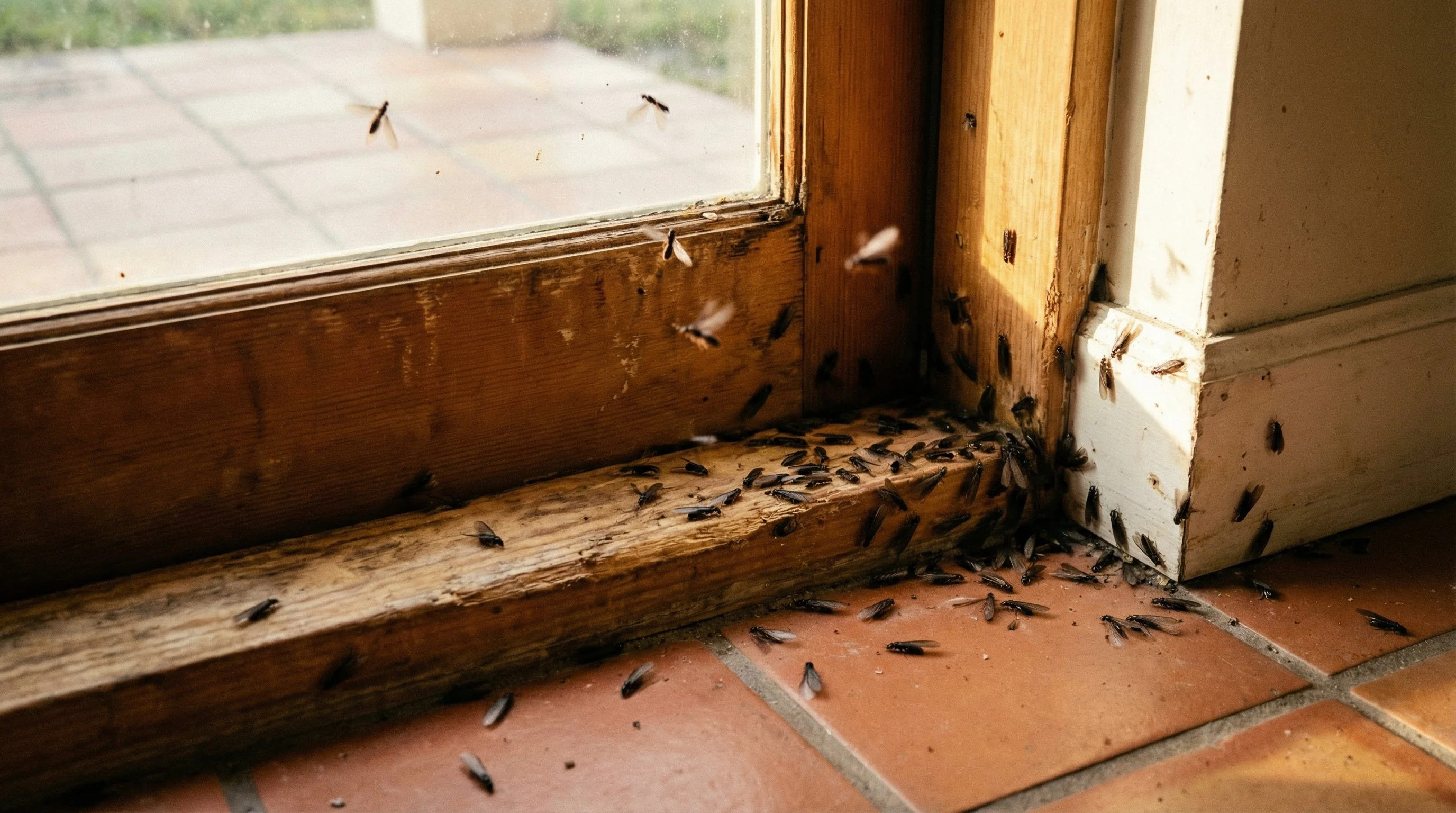
This is a source-linked geography guide, not a termite-risk ranking. Public sources do not publish verified treatment-call volumes or infestation rates by Miami-Dade ZIP code. I list ZIP codes to help homeowners find the right local context without inventing a ranking.
The direct answer
South Florida termite activity is most visible during the spring swarm window, but a ZIP code does not determine whether one home has an active colony. UF/IFAS describes species-dependent swarming and notes that termite activity is most visible from March through June. FDACS explains that Florida has multiple termite types and that proper identification matters because treatment varies by species.
For a Miami-Dade homeowner, the useful local question is not “Is my ZIP code ranked high?” It is “What did I see, where did I see it, and can a qualified professional identify the evidence?”
Miami-Dade ZIP-code field guide
The groups below are a practical service-area index based on public ZIP-code geography and the communities Dade Pest Solutions serves. They are not a map of termite presence, colony density, damage, or customer demand.
| Local context | ZIP codes | Communities |
|---|---|---|
| Homestead and South Dade | 33030, 33031, 33032, 33033, 33034, 33035, 33036, 33039 | Homestead, Princeton, Naranja, Leisure City |
| Cutler Bay and Palmetto Bay | 33157, 33158, 33189, 33190 | Cutler Bay, Palmetto Bay |
| Pinecrest, South Miami, and Coral Gables | 33133, 33134, 33143, 33146, 33156 | Pinecrest, South Miami, Coral Gables |
| Kendall and nearby DPS service communities | 33176, 33183, 33186, 33187, 33193, 33196 | Kendall, Country Walk, Silver Palm, The Crossings |
These are service-area reference ZIPs, not a termite-risk score. Postal ZIPs can overlap community boundaries, so confirm the property address when requesting service. The UF/IFAS termite distribution map is the authoritative public activity reference used for this guide; the U.S. Census Bureau geography reference files explain ZIP/ZCTA limitations.
What the public science says about seasonality
UF/IFAS explains that swarmers are easiest to observe during dispersal flights and that timing depends on species. In South Florida, UF/IFAS has documented Asian subterranean termite swarms in March, while other species have different seasonal patterns.
UF/IFAS also cautions that a winged termite inside a home does not automatically prove an infestation; multiple areas of shed wings or repeated evidence justify a proper inspection. FDACS likewise advises identifying the termite type because treatment choices differ.
That distinction is why this guide avoids making a ZIP-code claim that the public evidence cannot support. The UF/IFAS distribution map shows where termite species have been documented in Florida; it should be read as a species-distribution resource, not as a current infestation or treatment-demand map.
Expert Q&A with Shaun Judy
Shaun Judy is the founder and CEO of Dade Pest Solutions and holds FDACS Certified Operator Certificate JF293201. The answers below are practical guidance from DPS, not a substitute for a property-specific inspection.
Q: What should a homeowner do after seeing swarmers?
“Save a few specimens or take clear photographs, note the room and time, and avoid assuming that a consumer spray solved the problem. I recommend documenting the evidence and arranging an inspection when swarmers recur, wings accumulate, or mud tubes or wood damage are present.”
Q: Does March through June mean termites are inactive the rest of the year?
“No. That is the most visible period, not a guarantee that colonies stop feeding outside it. A quiet exterior does not prove a structure is clear, which is why inspection findings matter more than a calendar alone.”
Q: What is the most important local detail to report?
“Tell the inspector the exact location, whether the insects were attracted to a light, whether wings were shed, whether there are mud tubes or frass, and whether activity appeared in more than one area. Those observations are more useful than treating a ZIP code as a diagnosis.”
Frequently asked questions
Need a property-specific termite inspection?
Share what you observed and where you saw it. Our team can explain the next step without turning a seasonal swarm into an unsupported ZIP-code diagnosis.
Sources and method
- UF/IFAS Fort Lauderdale Research and Education Center: Swarming Events — species-dependent seasonal observations.
- UF/IFAS: Termite season Q&A — South Florida timing, identification, and inspection context.
- Florida Department of Agriculture and Consumer Services: Termites — Florida species and identification guidance.
- UF/IFAS termite distribution map — documented Florida termite-species distribution and map limitations.
- U.S. Census Bureau geography reference files — ZIP/ZCTA terminology and geographic limitations.