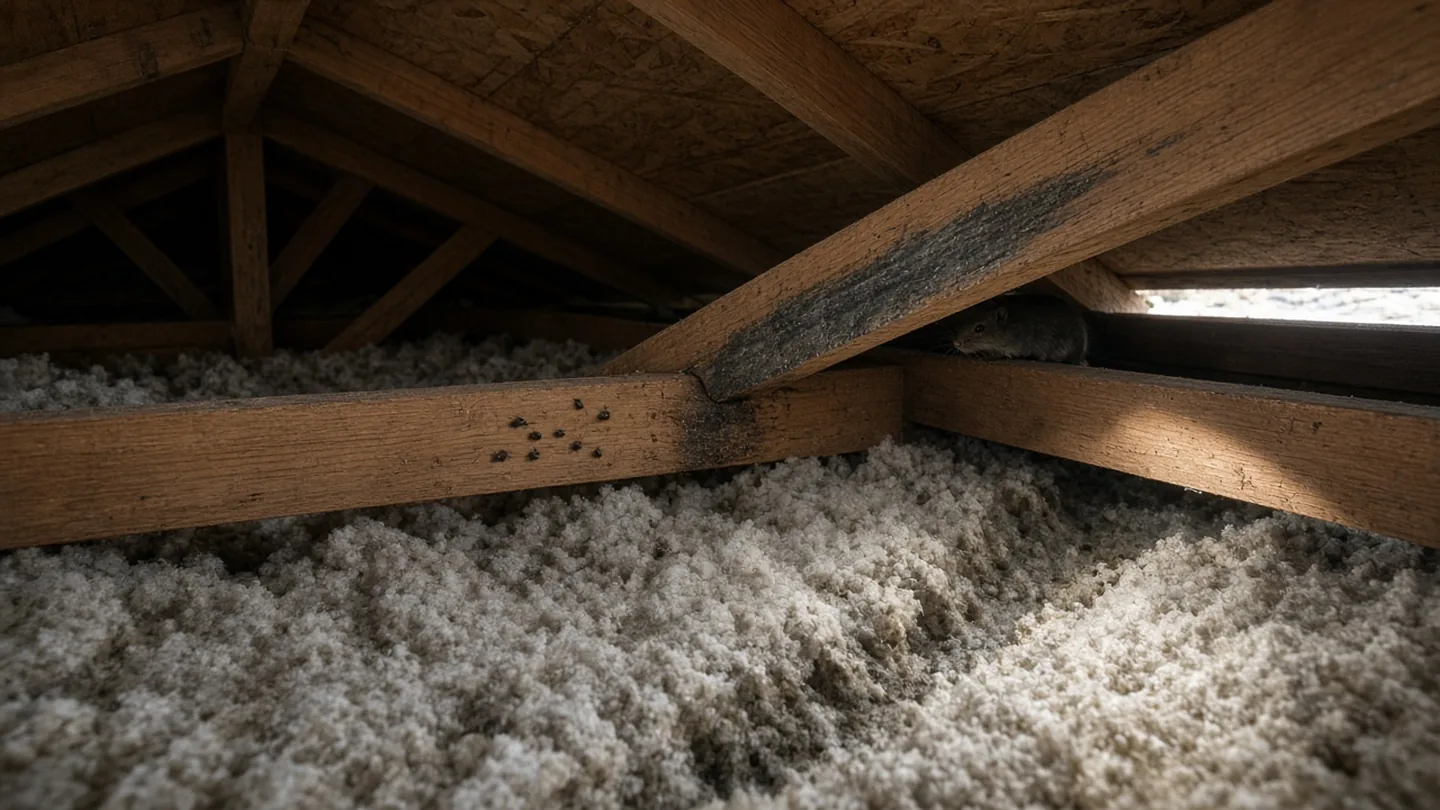
Short answer: If you hear scratching or running in the ceiling after dark, it is most likely roof rats. They climb trees, fences and power lines, then squeeze into the attic through gaps about half an inch wide. Trapping alone rarely ends it. You have to find and seal every way in, then remove the rats already inside.
Key facts
- The roof rat (Rattus rattus) is the most common rat in Florida. UF/IFAS calls it the state's worst rodent pest.
- Roof rats are climbers. They nest up high: attics, soffits, dead palm fronds and dense trees.
- A rat can squeeze through a gap about 1/2 inch wide. A mouse needs about 1/4 inch.
- Droppings are dark, spindle shaped and up to about 1/2 inch long.
- A female can have up to 6 litters a year with 6 to 8 young each, so a small problem grows fast.
- They are most active at night, which is why most people first hear them from bed.
How do I know it is roof rats and not something else?
The sound is the first clue. Roof rats are light and quick, so you hear scurrying, scratching and the occasional thump, usually starting after sunset and again before dawn. Squirrels are active during the day. A slow, heavy walking sound is more likely a larger animal.
Then look for proof. With a flashlight, check the attic, the garage ceiling and the top of the water heater closet for:
- Droppings along rafters, on top of insulation or near the attic hatch.
- Dark, greasy rub marks on wood where rats brush past on the same route every night.
- Trails or tunnels through blown insulation.
- Chewed wires, ductwork, AC line insulation or stored boxes.
- A sharp, musky smell in one area.
Outside, walk the roofline. Look for gaps at the soffit, loose fascia, roof vents without screens, gaps where pipes and AC lines go through the wall, and branches touching the roof.
Why do roof rats end up in South Florida attics?
Our yards give them everything they want. Mango, avocado and citrus trees feed them. Coconut and royal palms with old fronds hide them. Overhead power and cable lines, fences and trees give them highways straight to your roof. An attic is warm, dry and quiet, and nobody goes up there.
Roof rats are active here all year. Many homeowners first notice them in the cooler months, when windows are closed, the house is quieter at night and the noise overhead is easier to hear.
What actually gets rid of roof rats?
Three things, in this order. Skip one and they come back.
- Find every entry point. A proper inspection covers the whole roofline, soffits, vents, plumbing and AC penetrations, garage door corners and the attic itself. Missing one gap means the job is not done.
- Remove the rats inside. Snap traps placed along the runways in the attic are the standard approach. We do not recommend throwing poison bait in the attic. A poisoned rat often dies inside a wall or ceiling where you cannot reach it, and the smell can last for weeks.
- Seal the openings with rodent-proof material. That means sheet metal, heavy hardware cloth and mortar, not spray foam by itself. Rats chew right through foam. UF/IFAS recommends 19-gauge or heavier hardware cloth with openings no bigger than 1/4 inch, or 26-gauge or heavier sheet metal.
After sealing, keep checking for the first couple of weeks. Rats outside will test the new repairs, and any rats trapped inside will show up on the traps.
What can I do myself right now?
- Trim branches back so nothing touches the roof. Keep limbs several feet away from the roofline.
- Pick ripe fruit and pick up fallen fruit every day.
- Remove dead palm fronds and thin out dense vines on the house.
- Store pet food and birdseed in sealed containers. Do not leave pet bowls outside overnight.
- Screen roof and soffit vents.
- Do not sweep or vacuum droppings. See the cleanup section below.
These steps make your house less attractive. They will not remove rats that are already living in the attic.
Is it safe to clean up rat droppings myself?
Small amounts, yes, if you do it the safe way. The CDC says not to sweep or vacuum droppings, because that can put germs into the air. Instead:
- Open the space up and let it air out for about 30 minutes.
- Put on rubber or plastic gloves.
- Spray the droppings with a disinfectant or a fresh bleach solution (1 part bleach to 9 parts water) until they are soaked. Let it sit 5 minutes.
- Wipe up with paper towels, bag them, and throw them out in a covered trash can.
- Disinfect the area again and wash your hands.
Large amounts of droppings or contaminated insulation are a job for a professional.
South Miami-Dade notes
Roof rats show up in every city we serve, but the setting changes from place to place:
- Pinecrest, Coral Gables and South Miami: Big shade trees, heavy canopy and older homes with more gaps at the roofline. Branches touching the roof are the number one entry route we look for. See rodent control in Pinecrest, rodent control in Coral Gables and rodent control in South Miami.
- Kendall and Palmetto Bay: Lots of backyard mango and avocado trees and dense hedges. See rodent control in Kendall and rodent control in Palmetto Bay.
- Homestead and Cutler Bay: Fruit trees, palms and newer homes where AC line and pipe penetrations are often left unsealed. See rodent control in Homestead and rodent control in Cutler Bay.
When should I call a professional?
Call if you hear activity more than a night or two, find droppings in the attic, see chewed wiring, or catch rats and keep catching more. Those are signs of an established group, not a single visitor.
At Dade Pest Solutions, rodent work starts with our Rodent Defense Audit: a full inspection of the roofline, attic and entry points, with photos and a written plan. Exclusion and repair work is quoted after the audit, once we know exactly what your house needs. Learn more on our rodent control page.
Related reading: Rodent season in South Florida: real questions answered, Keeping rodents out of South Florida homes, What rodent removal costs in Miami-Dade.
FAQ
Do roof rats leave on their own?
Not usually. If they have food nearby and a dry attic to nest in, they stay and breed. Noise may move around the house, but that usually means they are traveling, not leaving.
Can roof rats chew through electrical wires?
Yes. Rats gnaw constantly to keep their teeth worn down, and wiring in attics is a common target. Chewed wires are a fire risk, so have an electrician check any damage you find.
Should I use poison in my attic?
We do not recommend it. Poisoned rats often die inside walls and ceilings, which causes odor and attracts flies. Trapping plus sealing the entry points is cleaner and more reliable.
How small a hole can a rat get through?
About 1/2 inch, roughly the width of a thumb. Mice can get through about 1/4 inch.
Will cutting back my trees solve the problem?
It helps a lot, but it is only one route. Rats also use power lines, fences, downspouts and rough walls. Trimming has to go together with sealing every opening.
Are roof rats dangerous to my family?
They can carry diseases and their fleas can spread murine typhus, which UF/IFAS lists as a roof rat concern. Avoid handling rats or droppings bare-handed, and follow safe cleanup steps.

About the author Shaun Judy, CEO, Dade Pest Solutions, FDACS Certified Pest Control Operator (personal FDACS certificate JF293201). Shaun has more than 17 years in pest control and holds the FDACS certification for termite/WDO and fumigation work. Dade Pest Solutions is family-owned, licensed and insured, FDACS business license JB337153, and based in Homestead. About Shaun
Sources
- UF/IFAS EDIS, Rat and Mouse Control (Koehler and Kern): https://doi.org/10.32473/edis-dh044-1997
- UF/IFAS EDIS, Control of Roof Rats in Fruit Trees (Kern): https://doi.org/10.32473/edis-uw120-1997
- CDC, How to Clean Up After Rodents: https://www.cdc.gov/healthy-pets/rodent-control/clean-up.html